Why Choose Aluminum Extrusion Profiles?
Why Choose Aluminum Extrusion Profiles? The answer starts with a useful balance: strength, low weight, and design flexibility. An Aluminum Extrusion Profile can form channels, ribs, slots, and mounting features in one continuous section. Picture a slim rail supporting a panel, with a groove ready for a fastener. Fewer separate parts can mean simpler assembly and fewer alignment points.
Materials-selection expert Michael F. Ashby’s work offers a practical reminder, paraphrased here: “Choose materials and processes together.” That principle matters because extrusion is not automatically the best answer. Designers must consider load, wall thickness, alloy, finish, and production volume. A profile that looks elegant on screen may prove difficult to manufacture or costly to finish. Small details matter.
Extruded aluminum also resists corrosion through its natural oxide layer, and finishes such as anodizing can add protection or color. It conducts heat well, making it useful in some enclosures and thermal applications. Yet performance depends on the complete design, not the material name alone. Check tolerances, connection methods, and service conditions early. It is easy to overlook a corner radius. A well-specified Aluminum Extrusion Profile can reduce part count and support repeatable production, but careful engineering still makes the difference.
What Are Aluminum Extrusion Profiles?
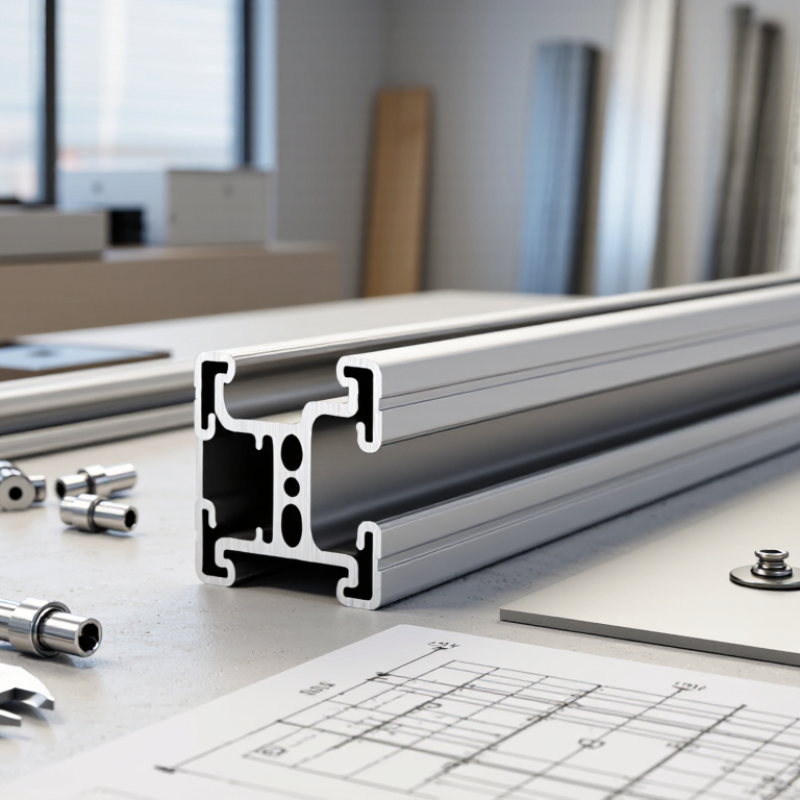
Aluminum extrusion profiles are shapes made by pushing a heated aluminum billet through a precisely shaped die. The die gives the metal a consistent cross-section, such as a flat bar, hollow tube, or channel with grooves. The profile keeps that shape along its length. Unlike a part cast in a mold, an extrusion can include useful details like slots or ribs without assembling separate pieces.
After extrusion, the profile is cooled, cut to length, and may be stretched or heat-treated to control its properties. Finishing options, including anodizing or powder coating, can improve appearance and surface protection. The right choice depends on the alloy, temper, dimensions, and intended load. A narrow channel may fit a sliding panel, while a ribbed section can help resist bending. Still, a design that looks simple on screen may be awkward to fasten or clean. That is worth checking early.
Tips: Ask for the alloy, temper, dimensional tolerances, and finish details. Check a sample against your actual fittings; small variations can affect assembly. Keep it practical.
How Are Aluminum Extrusion Profiles Manufactured?
Why Choose Aluminum Extrusion Profiles?
How Are Aluminum Extrusion Profiles Manufactured?
Manufacturing begins with an aluminum alloy billet, a solid cylinder cut to length. The billet is heated until it becomes pliable, then placed in a press. A ram pushes the metal through a shaped steel die, forming a continuous profile with the die’s cross-section. It may look simple. Die design, alloy choice, and temperature all affect how evenly the metal flows.
As the profile exits the die, it is cooled, often with air or water, depending on the alloy and shape. Workers then stretch it to correct bowing or twist before cutting it into specified lengths. Some profiles receive artificial aging in a controlled oven to develop required mechanical properties. Details matter. Thick and thin sections may cool at different rates, so process settings need careful adjustment.
The cut pieces are checked for dimensions, straightness, and visible surface defects. Depending on their intended use, they may also be anodized or painted. A smooth surface is useful, but it does not prove that every dimension is correct. That distinction is easy to overlook. Reliable production combines process control with inspection, while recognizing that complex shapes can require extra trials before they meet the drawing consistently.
Which Properties Make Aluminum Extrusions Valuable?
Aluminum extrusion profiles combine low mass with useful stiffness. The Aluminum Association’s Aluminum Design Manual gives aluminum a typical density of about 2.70 g/cm³ and an elastic modulus near 69 GPa. That balance can reduce frame weight while keeping parts sufficiently rigid for many applications. Think of a long equipment rail: lighter sections are easier to handle, yet carefully designed ribs can limit bending. The shape matters as much as the alloy. Not every profile performs equally well.
Extrusion also enables complex, repeatable cross-sections, including channels, slots, and integrated mounting features. These details can reduce machining and simplify assembly, though tight tolerances still require sound die design and process control. Corrosion resistance is another practical benefit; a naturally formed oxide layer protects exposed surfaces in many everyday environments. For harsher service, surface treatment or material testing may be needed. No shortcut here.
The International Aluminium Institute reports that recycling aluminum uses about 5% of the energy needed for primary production, a roughly 95% saving. That supports circular material use, but recycled content alone does not guarantee a lower-impact product; production energy and service life matter too. I would check the actual alloy, temper, load, and finish before specifying a profile. It is easy to overestimate a familiar material.
Where Are Aluminum Extrusion Profiles Commonly Used?
Aluminum extrusion profiles are commonly used in building systems, where their strength and low weight suit window frames, door tracks, and curtain-wall supports. A well-designed frame can hold glass securely while keeping sightlines narrow. On a construction site, installers also value profiles that can be cut and joined with ordinary workshop tools. Fit still matters. Poorly planned drainage or thermal breaks can cause problems, even when the profile itself is carefully made.
They also appear in machine guards, conveyor frames, lighting housings, and electronic enclosures. A factory may use grooved profiles to assemble a workbench, then reposition its brackets as equipment changes. In transport, extrusions can form trim, seat components, or structural sections when the design and load requirements allow. Solar-panel frames are another familiar use; their channels help hold panels and guide mounting hardware. Details vary. Alloy, wall thickness, and shape affect stiffness, corrosion resistance, and cost, so one profile rarely suits every job. It is tempting to focus on a tidy cross-section, but real performance depends on connections, finish, and the conditions around it.
What Factors Guide the Choice of an Aluminum Profile?
Choosing an aluminum extrusion profile starts with the job it must do, not with a catalog shape. Check the load, unsupported span, and allowable deflection; a long rail may bend even when both ends are firmly fixed. Look at how force enters the section. Thin walls and sharp internal corners can become weak points. Keep it practical. A profile that passes a strength check may still be awkward to assemble.
Alloy and temper affect strength, machinability, and finish, so specify them against real operating conditions. For an outdoor frame, consider moisture, temperature changes, and the coating or anodizing process. For a sliding part, check straightness, surface contact, and clearance; small dimensional errors can cause binding. Measure the whole assembly, not just one extrusion. That detail is easy to miss.
Also consider cutting, drilling, joining, and fastener access before finalizing the cross-section. A complex shape can reduce part count, but it may raise tooling costs or complicate inspection. Ask a qualified engineer to verify loads and tolerances when failure could affect safety. In practice, the best choice is sometimes not the lightest one. It is the profile that can be made consistently and fitted without forcing parts into place.