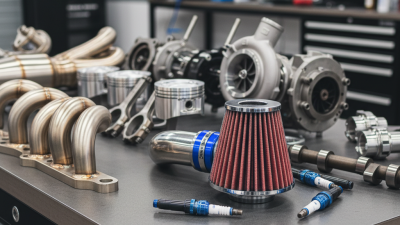
Sourcing quality engine components from global suppliers is no longer a simple price comparison. It is a controlled investigation. Buyers must examine metallurgy, machining accuracy, traceability, testing, and after-sales support before approving a parts engine supplier.
The market is substantial. The Auto Care Association reported that the United States automotive aftermarket reached approximately $500 billion in 2023. Its 2024 Joint E-commerce Report also identified continued growth in online parts purchasing. Meanwhile, Deloitte’s 2024 Global Automotive Supplier Study highlighted persistent cost pressure, supply-chain risk, and technology investment challenges for suppliers. These findings suggest a practical lesson: low unit pricing can hide expensive defects, delayed shipments, or weak technical support.
Bill Hanvey, president and CEO of the Auto Care Association, has described the aftermarket as “the ultimate circular economy.” That idea matters when evaluating parts engine suppliers. A reliable supplier should provide batch numbers, material certificates, dimensional inspection records, and clear warranty terms. Ask for sample parts. Measure them independently. Inspect packaging before shipment.
The process is not perfect. A polished factory tour proves little by itself. Certifications can also become outdated. Buyers should verify certificate numbers, audit production records, and compare test results with purchase specifications. Intertek, TÜV Rheinland, or another qualified inspection body can support independent checks.
A strong sourcing plan balances cost, consistency, lead time, and communication. It also keeps a second approved supplier ready. That extra step may feel excessive. In practice, it can protect production when one port closes, one machine fails, or one supplier stops answering.

Sourcing quality engine parts from global suppliers starts with a precise specification. In my experience, vague requests create expensive misunderstandings. State the exact part number, engine application, dimensions, material grade, surface treatment, and acceptable tolerances. Include operating temperature, pressure, load, and expected service life. A connecting rod, for example, may require bore diameter accuracy within a defined range and hardness testing after heat treatment.
Quality requirements should be measurable and documented. Request inspection reports, material certificates, dimensional records, and batch traceability. Define sampling levels before production begins. For critical components, require first-article inspection and functional testing. A supplier should explain its calibration process, not simply promise “premium quality.” I have seen attractive samples fail during endurance testing. Visual inspection alone is not enough. Specifications can still miss real operating conditions, so review them with an experienced engineer and revise weak points.
Tips: Send a marked technical drawing. List approved materials and test methods. Ask for photos of production and packaging. Confirm how rejected parts are controlled. Keep one reference sample for comparison. Do not accept unclear tolerances. Small details matter.
Finding a global engine-parts supplier starts with a narrow, measurable requirement. Share the part drawing, material grade, tolerance range, heat-treatment requirement, and expected annual volume. Vague requests invite vague quotations. Ask suppliers to provide factory addresses, production capacity, inspection equipment, and traceability procedures. Evidence matters more than polished presentations.
Request recent dimensional reports, material certificates, sample photos, and a clear nonconformance process. Check whether certificates match the actual facility and production process. Some traders present themselves as manufacturers. That distinction can change quality control, lead time, and accountability. Use independent records, video calls, and carefully documented questions to test their claims. Do not rely on price alone. Compare tooling ownership, minimum order quantities, packaging, delivery terms, and replacement responsibilities.
For critical components, order samples before signing a long-term agreement. Measure them with calibrated tools, then inspect surfaces, threads, hardness, and fit. A small mismatch may become an expensive engine failure. Ask for a controlled corrective-action report when results miss specification. Good suppliers explain the cause, containment, and prevention steps. Still, no evaluation is perfect. A remote audit may miss a worn fixture or rushed final check. Build protection into the relationship through staged orders, inspection milestones, and written acceptance criteria. Review performance after each shipment, not only after a problem appears. That discipline feels slower. It is usually cheaper than discovering quality issues inside assembled engines.
| Evaluation Dimension | What to Verify | Recommended Benchmark or Requirement | Acceptable Evidence | Priority | Weight | Score 1–5 |
|---|---|---|---|---|---|---|
| Quality Management System | Whether the supplier operates a documented and independently audited quality system. | Valid ISO 9001 certification as a minimum. IATF 16949 is preferred for suppliers producing automotive production parts. | Current certificate, certification scope, issuing body, expiry date, audit findings, and corrective-action records. | Mandatory | 15% | — |
| Engineering Capability | Ability to interpret drawings, control revisions, perform tolerance analysis, and support design-for-manufacturing reviews. | Documented engineering change process; competent use of CAD, GD&T, material specifications, and inspection planning. | Engineering organization chart, sample design review, revision-control procedure, capability list, and anonymized technical reports. | Mandatory | 10% | — |
| Material Traceability | Traceability from incoming raw material to finished part and shipment batch. | Lot-level traceability covering heat or batch number, supplier certificate, production date, operator or equipment record, and final inspection result. | Sample material certificate, traveler, barcode or ERP record, retention policy, and mock traceability exercise. | Mandatory | 12% | — |
| Process Capability | Stability of critical manufacturing processes and control of key product characteristics. | For critical characteristics, require documented capability studies. A common internal screening target is Cpk ≥ 1.33 after process stabilization, unless the drawing or customer standard specifies otherwise. | Control plans, process-flow diagrams, PFMEA, capability studies, SPC charts, and reaction plans. | Mandatory | 14% | — |
| Product Validation | Evidence that the part meets dimensional, material, durability, thermal, pressure, and functional requirements. | Validation plan aligned with the part risk and intended engine application; testing must use approved specifications and calibrated equipment. | Dimensional report, material analysis, hardness or coating results, functional test data, endurance results, and signed approval records. | Mandatory | 13% | — |
| Production Part Approval | Readiness to submit production-quality samples and the required approval package. | Ability to support PPAP or an equivalent first-article approval process, including samples, dimensional results, material results, process documentation, and capability evidence. | Anonymized previous submission index, sample inspection package, control plan, PFMEA, and nonconformance response process. | Preferred | 10% | — |
| Defect Prevention and Corrective Action | How nonconformities are detected, contained, investigated, and permanently eliminated. | Formal 8D or equivalent root-cause process; containment notification within one business day for critical defects and documented effectiveness verification. | Redacted 8D reports, customer complaint log, defect Pareto, containment procedure, and corrective-action effectiveness records. | Mandatory | 10% | — |
| Capacity and Delivery Reliability | Available capacity, production flexibility, planning discipline, and ability to meet agreed delivery dates. | Confirmed monthly capacity above forecast demand, documented bottleneck controls, and an agreed lead-time window with escalation rules. | Capacity map, equipment list, staffing plan, production schedule, on-time-delivery history, and business-continuity plan. | Mandatory | 8% | — |
| Tooling and Maintenance | Ownership, condition, preventive maintenance, calibration, and replacement planning for molds, dies, fixtures, and gauges. | Asset register with identification, maintenance frequency, service history, spare-part plan, and defined tooling ownership terms. | Tooling register, maintenance records, calibration certificates, gauge repeatability studies, and replacement-cost agreement. | Preferred | 6% | — |
| Regulatory and Chemical Compliance | Compliance with applicable restrictions on substances, environmental obligations, and market-specific requirements. | Documented review of applicable requirements such as REACH and RoHS where relevant; material declarations must match the supplied part and revision. | Material declarations, laboratory reports, compliance statements, restricted-substance procedure, and change-notification records. | Mandatory | 5% | — |
| Commercial Transparency | Clarity of pricing, payment terms, tooling charges, minimum order quantities, warranty, and cost-change mechanisms. | Quote must identify unit price, tooling or setup cost, packaging, logistics terms, currency, validity period, payment terms, and price-adjustment conditions. | Itemized quotation, cost breakdown, draft supply agreement, warranty terms, and sample commercial risk assessment. | Mandatory | 4% | — |
| Logistics and Packaging | Export capability, packaging protection, labeling accuracy, shipment documentation, and transport-risk management. | Packaging must prevent corrosion, contamination, deformation, and mix-ups throughout the planned transport route; shipping documents must support lot traceability. | Packaging specification, transit-test results where applicable, carton labels, packing list, commercial invoice, and Incoterms® 2020 proposal. | Preferred | 4% | — |
| Financial and Business Continuity Risk | Financial stability, dependency on key customers, supply-chain resilience, and disaster recovery capability. | Documented continuity plan covering critical equipment, utilities, labor shortages, cyber incidents, natural disasters, and alternate sources for key materials. | Financial review, insurance evidence, continuity plan, recovery-time targets, alternate-material strategy, and risk register. | Conditional | 5% | — |
| Total Evaluation Weight | 100% | — | ||||
How to Source Quality Engine Parts from Global Suppliers?
A reliable engine parts supplier should provide more than a polished catalog. Ask for current certificates, issuing bodies, covered facilities, and expiration dates. Check whether each certificate applies to the actual production site. A document for another factory is not enough. Request manufacturing records that show material grades, heat numbers, and inspection dates. These details create a traceable link between raw material and finished part.
Manufacturing standards must match the part’s function and destination market. Review process controls for casting, machining, heat treatment, and surface finishing. Ask how workers measure bore diameter, hardness, balance, and sealing surfaces. Independent factory audits can reveal worn tools, weak calibration systems, or incomplete records. I have found that a clean audit report does not always reflect daily production. Repeat checks matter. Samples should undergo dimensional inspection and, where suitable, laboratory testing before shipment.
Product authenticity requires careful comparison. Match labels, markings, drawings, packaging details, and serial records against the supplier’s technical file. Request high-resolution production photos, not only warehouse images. A small trial order can expose inconsistent tolerances or altered materials. Keep retained samples and inspection reports for future claims. No checklist is perfect. Human error remains possible, especially when documents are translated poorly or copied between suppliers. Build direct communication with the quality manager, verify unexpected changes, and record every approval in writing.
Recommended weighting for a 100-point supplier verification model covering certifications, manufacturing standards, and product authenticity.
ISO 9001 and IATF 16949 certification evidence should be checked alongside process audits, material test reports, batch traceability, and documentation that confirms product authenticity. The weighting is an illustrative due-diligence framework rather than a supplier performance ranking.
Sourcing quality engine parts begins with comparable quotations, not the lowest number. Ask each supplier to quote identical specifications, materials, tolerances, testing, and packaging. Request prices for 50, 200, and 1,000 pieces. This reveals volume breaks and hidden tooling charges. Check whether taxes, inspection fees, and export documents are included. Keep every assumption in one sheet. Small omissions become expensive later.
Minimum order quantities deserve practical testing. A low MOQ may help a trial, but it can raise unit cost sharply. A high MOQ can trap cash and create aging inventory. I usually request a pilot batch with dimensional reports and sample photos. Then I compare defect rates, rework time, and response quality. Numbers matter. So does evidence. One past mistake taught me not to trust a polished quotation without confirming production capacity.
Lead times should be divided into approval, production, inspection, and dispatch. Ask for a written schedule and a delay procedure. Shipping terms need equal attention. Clarify who controls freight booking, insurance, customs paperwork, and delivery risk. Compare air, sea, and consolidated freight against the required arrival date. A cheap term may shift work to your team. Add buffer days for port congestion and inspection delays. I still leave too little buffer sometimes; that is a planning weakness worth correcting.
A polished sample can hide production instability. Inspect more than appearance. Measure bore diameter, surface finish, hardness, weight, and oil-channel cleanliness against approved drawings. For rotating engine parts, check balance and material certificates before testing performance. Record each result with photographs, instrument IDs, and lot numbers. A sample without traceable evidence is only a promise.
Use a controlled inspection plan for every supplier. Require first-article approval, capability studies, and documented corrective actions. ISO Survey 2023 recorded more than 1.26 million ISO 9001 certificates worldwide, yet certification alone does not prove consistent engine-part quality. Audit the processes behind the certificate. Review calibration records, heat-treatment controls, inspection frequency, and change notification procedures. Small changes in tooling can create large failures.
Ongoing performance needs measurable signals. Track defect rates in parts per million, on-time delivery, response time, and corrective-action closure. McKinsey Global Institute reported that major supply-chain disruptions could erase 45% of one year’s profits over a decade. That risk makes supplier monitoring a financial discipline, not paperwork. Set clear escalation thresholds and review scorecards monthly. Poor results should trigger a root-cause meeting, not an immediate accusation. A weakness remains: sampling may miss defects between inspected pieces. Increase checks for new suppliers, unstable processes, and safety-critical components. Reduce them only after reliable data proves control.